Mickey Harris
Preparation meets opportunity
Photos by Joseph Tipton
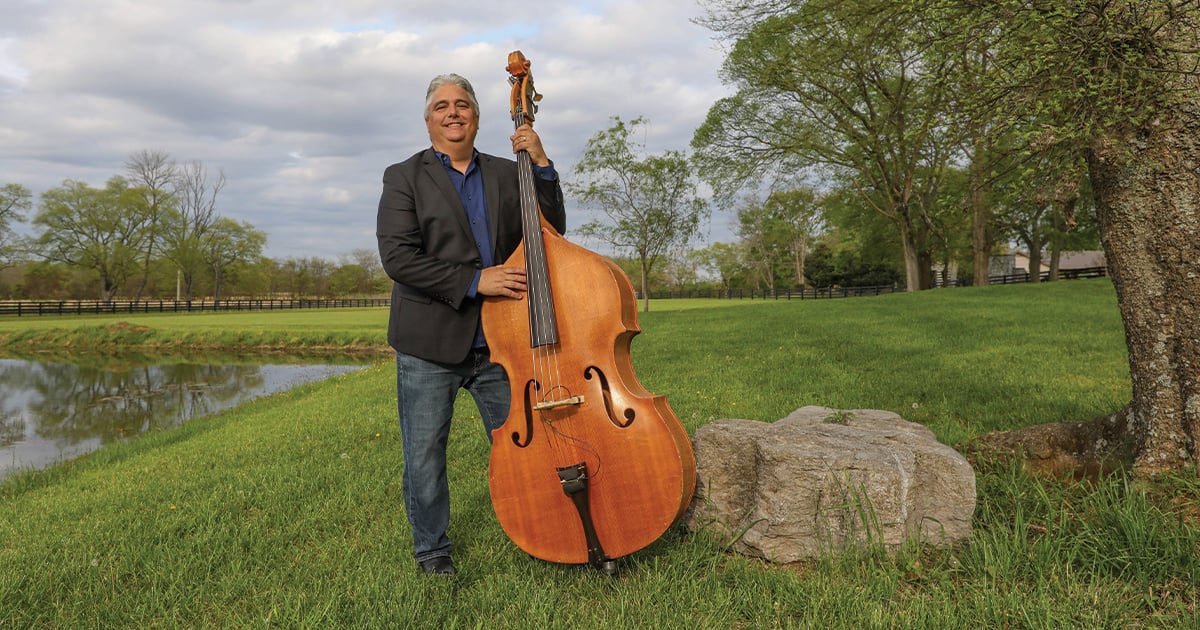
For a Murfreesboro, Tennessee-based multi-instrumentalist whose musical roots stretch back six generations and predate the 1927 Bristol Big Bang, Mickey Harris is remarkably low-key. That simple acceptance of a musical heritage is the basis for his career with High Lonesome, Tim Graves and Cherokee, Larry Stephenson, Sally Jones & the Sidewinders, and most recently his 20-year tenure as bassist and vocalist with Rhonda Vincent & The Rage.
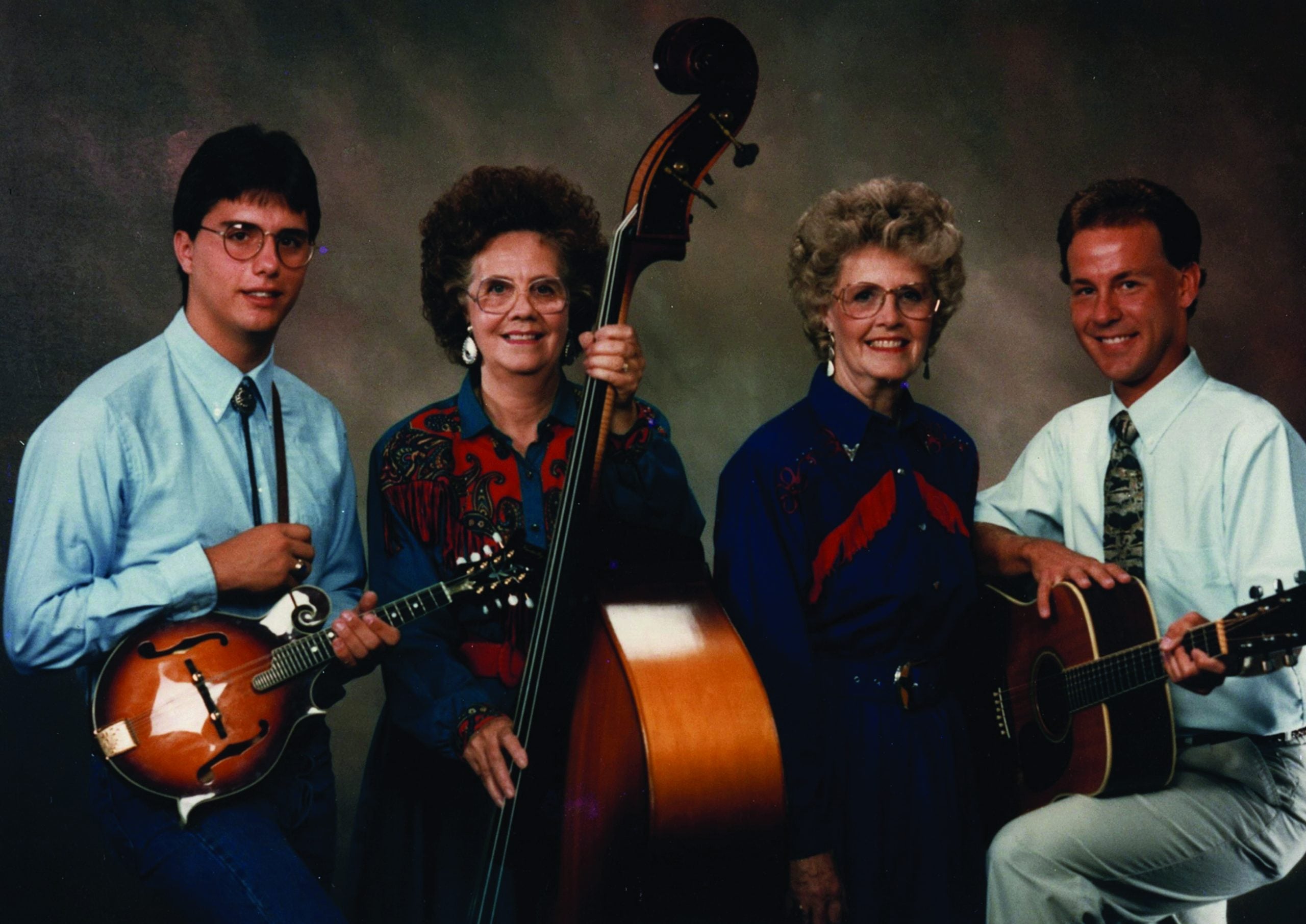
Mickey’s musical training began early. “For 25 or so years, my great-uncle Carl Tipton hosted The Carl Tipton Show on Nashville TV. I grew up attending the show and meeting all the guests,” recalls Mickey. “I got to know a lot of people that way. I started playing Dobro® when I was around eight years old, and then moved to electric bass at ten. My grandfather Jack Tomberlain needed a bass in his bluegrass and country band, so he bought me an electric bass for my birthday, which my grandmother Louise then taught me to play. One of my first band jobs was backing up Jimmy C. Newman at one of his local performances. At age ten! We’d also play at area nursing homes and the VA hospital in Murfreesboro and do shows around middle Tennessee.” Mickey also performed with his family’s band, The Tipton Family Band, and backed up various artists at Murfreesboro’s Uncle Dave Macon Days.
By age 12, Mickey had gotten tall enough for an acoustic bass, which solidified his fascination with the instrument. “My great aunt Sophie, who was married to Uncle Carl and played bass in his band, always had an acoustic bass at her house. I played it whenever I was there, and I played it a lot. Finally, she just told me to take it home.”
Until he was 17, Mickey played with the family band, touring throughout Tennessee, Alabama, and Kentucky.
In his last year of high school, the family band joined the national Sisters of the South tour. “That was my first taste of being on the road nationally, and I got to meet the New Coon Creek Girls with Dale Ann Bradley. My friend Deanie Richardson, who had been playing on The Carl Tipton Show since she was very young, was part of the New Coon Creek Girls. I then became friends with the whole group. That tour was a great chance to meet a whole lot of neat folks and play all over the country. After that tour, the New Coon Creek Girls approached me about a job as their mandolin player. They explained that they were thinking about changing the band name and putting Dale Ann Bradley out in front. Since I was still in high school, I really couldn’t travel as much as that band would need, but I really appreciated that recognition.”
Embarking on his musical journey apart from the family band seemed the next logical step. In 1994, a group of young middle-Tennessee-based musicians, who had come to know each other from regional tours and musical contests, coalesced into the first incarnation of the band High Lonesome. Joining Mickey were Cody Kilby, Brian and Greg Blaylock, and Don Hill. “We got to play at the 1996 Olympics in Atlanta, which for me was one of the highlights of working with those guys. Playing and singing lead with High Lonesome helped me appreciate how the vocals and the instruments, especially the bass, need to come together,” Mickey notes.
“At age ten, when I had the chance to back up Jimmie C. Newman, I was not that familiar with his music. It hit me: if I wanted to be good bass player, I needed to be familiar with different kinds of music from different artists. I just started listening to everything. I also got to play with artists like Ferlin Huskey, Bill Carlisle, and others who were family friends. By the time I was 15, I had a good musical foundation and really started to expand my repertoire.”
That “familiarity with everything” is the heart of Harris’ fundamental style: “I play simply. I focus on timing and supporting and uplifting the rest of the band. I love to sing, especially harmony, so I really listen to and complement the singer. Of course, I have certain bass players I’ve always loved to listen to, and I’ve taken a little from this one and a little from that one to create my own style. I try to accent the various instruments as they come in. I think all that comes from when I played with High Lonesome.”
“Familiarity with everything” generates its own opportunities. “That came in really handy a number of years back [in 2005] when Rhonda was sick, and we had to cancel about a month of shows. Del McCoury was filling in for a lot of our festival slots. This was after Mike Bub had left his band, so Del asked me to play with them. By this time, I knew every Del McCoury song, so when I flew up to a festival in Connecticut Del asked me to meet him backstage right before the show. He asked me some questions about two or three tunes, whether I knew the kickoff to ‘Vincent Black Lightening’ and could sing harmony on ‘Nashville Cats.’ I said yes, and Del said ‘well, I think we’ll be just fine.’ I had never played with them before, but we had a great time playing that festival. Just being familiar with the work of other artists early on in my career was excellent preparation for opportunities later. Once I even got to play with Bill Monroe, which I consider an honor.”
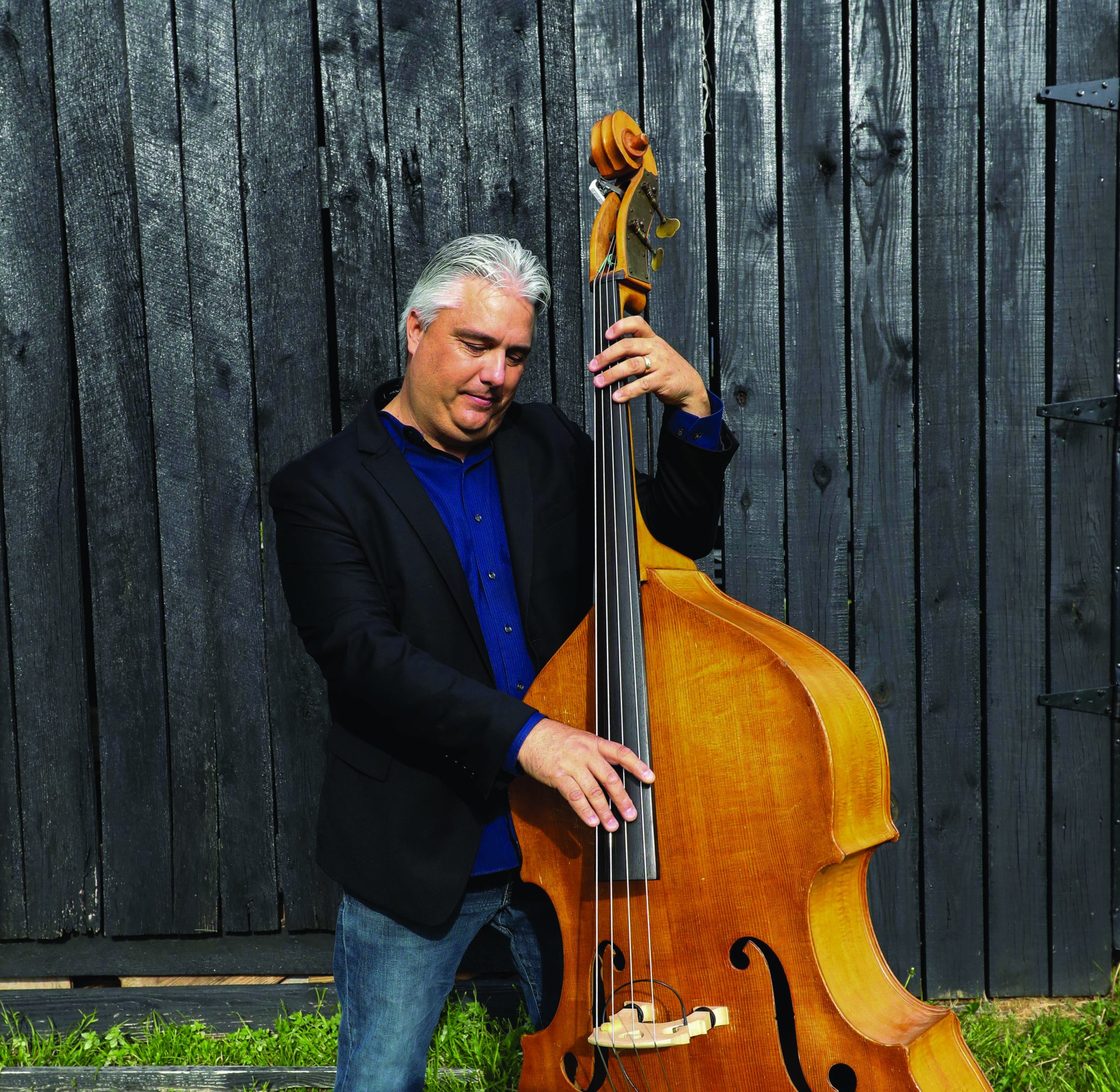
Having an ear for a good bass also helps. “Since I had flown to Connecticut for the Del job, I didn’t have a bass with me. Festivals usually have a bass for just these situations, but not this time. I walked around the campsites and parking lot picking sessions, and when I heard a good-sounding bass, I asked the owner if they would allow me to play the bass on stage with Del. ‘Absolutely!’ was the answer. I’ve met a lot of nice folks through the years, who let me borrow their basses. Now The Rage flies with a Chadwick folding bass, which sounds pretty good. Through the years I’ve had some great basses and some really bad basses. [Mickey laughs] The bass I play right now is a blonde 1940 Kay M1. I found it when my family was down in Florida on vacation. A jazz bassist was retiring from the road, so he was selling it. It needed a little work, but it’s a wonderful bass. Right now, I’ve got a few other basses, but my favorite is that 1940 Kay. It plays great and is one of the better recording basses I’ve had.”
Although Mickey has taught at a few camps over the years, “mostly up in British Columbia, Canada when I worked with Sally Jones & the Sidewinders and Chris Jones & The Night Drivers,” he readily admits that he’s not formally trained. “My Aunt Sophie showed me the basics, and then I watched and listened. For my students, I do the same: I show them what I do and then encourage them to play a lot, develop their ear, and feel the timing. Playing simply at first is critical. After that you add the walk-ups, the walk-downs, accents, and other advanced techniques. Learning to play today—with the DVDs and YouTube tutorials now available—might be easier, but the fundamentals remain the same. I feel the key to be a working bass player is being familiar with a wide spectrum of music. That helped when I was working with Chris and Sally Jones. Chris’s music sounds straightforward but is really complicated to play. It’s a lot different from than the more traditional bluegrass styles. Being versatile is essential nowadays, as well as listening to a variety of music and getting to know other musicians. It just helps to know other artists’ repertoire in case you are called to play in any situation.”
Mickey’s familiarity with a broad range of styles, his focus on the fundamentals, and his ability to fit into a band are major factors for his 20 years with Rhonda Vincent & The Rage. “Whenever I joined an existing band, I always did my research, listening to recordings the band had made before me. Darrin [Vincent, Rhonda’s brother] is a wonderful bass player, so I had my listening work cut out for me.” On stage, the band’s genial joking demonstrates the band’s tightness, both musically and personally. “After 20 years with only a few personnel changes, we’ve grown to be a family that gets along together well, both on-and-off-stage. I started filling in occasionally with Rhonda in 2000 & 2001, although I was still committed to working with Sally Jones & the Sidewinders. I joined Rhonda full-time in 2002. She hired Kenny Ingram on banjo and Hunter Berry on fiddle. When Kenny left, we added Aaron McDaris on banjo and then Zack Arnold came in when Josh Williams left. Now we have Jeff Partin on Dobro. It’s a pretty tight musical family.”
During Mickey’s career with Rhonda, the band has won one Grammy award and been nominated two more times. They have also won numerous industry awards. Mickey has added a few individual trophies to his cabinet as well: he has been the SPBGMA “Bass Player of the Year” seven times and has been nominated for IBMA “Bass Player of the Year.”
Tied into Mickey’s 20th anniversary with The Rage is his latest solo project, slated for a July release, which corresponds to the month he joined The Rage. Things That I Like is his sixth CD. “I recorded it with The Rage; we’ve featured all the guys in the band with special guest Jim Van Cleeve on fiddle on three tunes. I produced it, and Jeff Partin engineered it. Rhonda sings lead on the Nancy Sinatra pop hit “These Boots Are Made for Walkin’.” My mom really liked that song, so I included it in memory of her. It’s a bluegrassy-swingy acoustic reworking of the song, with that great upright bass opening and a dominant bass line throughout. I wrote three original songs, one of which is “God Is Watching.” It’s a gospel quartet I co-wrote with my grandmother Louise, who recently passed away. My son Jackson sings bass on it as well. Then we do some covers of tunes I’ve listened to over the years and wanted to record, which is why the album is Things That I Like. It’s full of different types of tunes, from Buddy Holly and James Taylor to Alabama and Bill Monroe, all done with a bluegrass feel. I included one original instrumental where I feature myself on mandolin. “Dreaming in Minors” actually came to me in a dream. I got up, grabbed my mandolin and phone, and recorded it before I could forget it. This is the sixth solo album I’ve recorded since I’ve been traveling on the road.”
[For the record, Mickey’s previous projects were Kneel and Pray, Dog House Blues, A Gospel Collection, Find My Way Home, and before that Long Lonesome Highway, which he recorded back in the late 90s when working with Larry Stephenson.]
For all his time spent with Rhonda Vincent & The Rage, Mickey still tours the hospitals and nursing homes in Murfreesboro with some non-professional picking buddies. Now, however, Mickey brings along his 14-year-old son Jackson. “He’s doing great on guitar, mandolin, and bass as well as songwriting,” Mickey notes. “And if he’s at one of our shows, Rhonda always gets him up to sing with us. She even brought him on stage with us when we played the Ryman, and it was his birthday. I’m just proud to be passing the torch along. My daughter Mikayla is 16 and has a great voice, but she’s focusing on other artistic venues like painting, writing, and drawing. She’s amazing at what she does.”
Mickey continues: “I especially want to thank my wife Crystal for being so supportive over the years; she’s the rock of our family. We’ll have been married 20 years this year. In fact, we got married on July 20th, 2002, one week after I joined up with Rhonda & The Rage. So, this July I celebrated 20 years of marriage, 20 years of being in the Rage, and I’ll release Things That I Like in July as well. I also want to say thanks to all of the fans and friends that I’ve made over the last 35 years in music. You have become an extended musical family. 2022 is a pretty great year, all around.”
Mickey expects his personal website (www.mickeyharrismusic.com) will be up by the time Things That I Like is released.